
How do you buy a push bumper for your vehicle fleet? How can you tell what’s high quality and what’s not? If you simply pull a part number off last year's order, is that good enough?
One thing is certain: you don’t want to wait until an officer makes contact with a fleeing vehicle at 40 mph and to find out what that part number was actually rated for.
That is a bad moment for a surprise.
It is also not a rare moment. The Bureau of Justice Statistics counted roughly 68,000 vehicle pursuits by state and local agencies in a single year. In BJS pursuit records, 15% ended in a collision, and about 1 in 200 ended in a death.
A push bumper is the primary piece of equipment on a patrol vehicle designed to take a deliberate collision. Everything else on the car exists to avoid one. That makes it worth more than five minutes of thought.
Here is what a push bumper for police cars does, how it differs from similar products, and the five questions that separate a good buy from an expensive one.
What Is a Police Push Bumper?
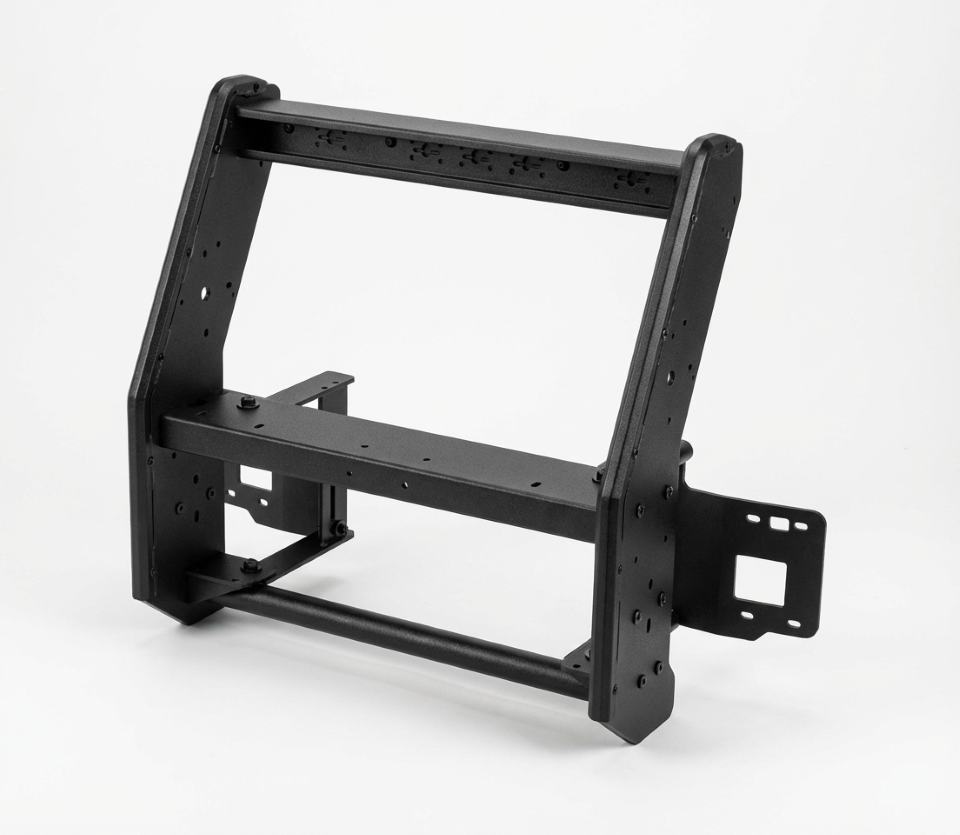
A police push bumper is a steel or aluminum guard mounted to the front frame of a patrol vehicle. It protects the grille, headlights, and radiator from impact. It also gives officers a controlled contact point for pushing disabled vehicles off the roadway and for executing a PIT maneuver, also called a tactical vehicle intervention. Research compiled for the Florida Department of Law Enforcement credits the Fairfax County, Virigina police with first using the technique in 1985
You will also hear it called a push bar, a brush guard, or a ram bar. Generally these refer to the same product, with different regional names.
What a Push Bumper Does on Shift
- Clearing the roadway. Stalled cars and some large debris blocking a lane. An officer can move them without waiting on a wrecker.
- Absorbing the small stuff. Parking lot taps, curb contact, shoulder work. The bumper takes it instead of the fascia.
- Protecting what is expensive. Grille, headlights, hood latch, cooling stack. A cracked radiator takes a car out of service for days.
- Controlled contact during a PIT maneuver. This will make or break which push bumper you purchase.
Most shifts, a heavy-duty police push bumper protects from smaller incidents. A few times a career, it is the difference between a vehicle that finishes the task and a vehicle that gets towed.
Proven Where It Counts
Every manufacturer says their law enforcement push bumper is tough. “Tough” means nothing without a test behind it.
Tenhold ran its push bumper through professional tactical vehicle intervention testing on real vehicles, with instructors who run PIT maneuvers for a living.
52 runs. Zero structural failures. Fully protected and field-ready vehicle.
During testing, we only saw cosmetic scuffing on the push bumper at the contact face – no cracked welds, no deformed uprights, no mount separation.
That is one data point, not a warranty. Service life in the field depends on the vehicle, the mounting, the speed and the angle. But it is a real number from a real facility, and it is the question worth asking any vendor you are considering.
When purchasing a push bumper, ask how many tests were conducted and what the failure rate was. This will help you tell the difference between true quality and a sales claim.
Push Bumper vs. Bull Bar vs. Grille Guard
A push bumper, a bull bar, and a grille guard are three different products built for three different jobs. Purchasing paperwork treats them as interchangeable, and that is how an agency ends up with a patrol car that looks equipped for pursuit work and is not.
Here is how to tell them apart before you approve a spec:
Push bumper. Frame-mounted. Built for deliberate vehicle-to-vehicle contact. This is the pursuit tool.
Bull bar. A center bar across the lower grille. Light-duty guard and accessory mount. Not engineered for pursuit contact. Common on trucks, wrong for patrol.
Grille guard. Full-face cage protecting the grille and headlights. Good against animal strikes and brush. Heavier, restricts airflow on some builds, and not designed for controlled contact with another vehicle.
| Push Bumper | Bull Bar | Grille Guard | |
|---|---|---|---|
| Vehicle-to-vehicle contact | Yes | No | No |
| Built for PIT maneuvers | Yes | No | No |
| Frame mounted | Yes | Varies | Yes |
| Airflow impact | Minimal | Minimal | Moderate |
| Typical use | Patrol and pursuit | Accessory mount | Animal and brush strikes |
If your fleet runs pursuits, you need a push bumper. The other two solve different problems.
Do Push Bumpers Damage the Vehicle?
This is the question fleet managers ask most, and the honest answer has two parts.
Cosmetically, yes. Contact transfers paint and scuffs finish on both vehicles. That is the job. Wraps and replaceable bar covers on the contact face keep it to a wear item instead of a repair.
Structurally, that depends entirely on mounting. A push bumper tied into the vehicle frame routes impact load into the structure engineered to carry it. A universal bracket kit routes that load wherever the bracket happens to land, which can mean bent sheet metal, elongated bolt holes and a body shop invoice.
The bumper is rarely what damages a patrol car. The mount is.
Choosing the Right Push Bumper for Your Fleet
Five questions decide whether a push bumper purchase holds up over a fleet lifecycle. Ask them your vendor, including us, to find the right fit for your fleet.
1. Is it built for your exact vehicle?
A push bumper for police cars is not universal. Frame geometry, sensor and light accommodations, and crash structure change every model year. Vehicle-specific mounting spreads load into the frame the way the engineer intended. Tenhold builds vehicle-specific for the Ford Police Interceptor Utility, the Chevrolet Tahoe and the Dodge Durango.
2. Has it been impact tested, and can they prove it?
Ask for the run count, the testing facility, and the number of failures. Tactical vehicle interventions or PIT maneuvers are not the time to find out whether your fleets push bumpers have stood up to rigorous testing.
3. Can you see (not guess) when the push bumper makes contact?
Many push bumpers have no line of sight for officers attempting to make contact with another vehicle. Rather than guessing when vehicle contact will be made, ensure your fleet’s push bumpers allow officers to see where the PIT point will be from the driver’s seat.
4. How fast does it install?
Multiply install time by fleet size. An hour saved per vehicle across 60 cars is a week and a half of tech time. On a fleet-wide rollout, install labor can rival the hardware cost.
5. Is it compatible with your lights and speakers?
Look for features like universal light mounting, easy access for electrical wiring, or speaker and sidelight compatibility.
Browse the full Tenhold push bumper lineup, or contact our team and we will spec it against your fleet list.
Frequently Asked Questions
What is a police push bumper?
A police push bumper is a frame-mounted steel or aluminum guard on the front of a patrol vehicle. It protects the grille, headlights and radiator, gives officers a contact point for pushing disabled vehicles, and provides the structure needed to perform a PIT maneuver safely.
Why do police vehicles use push bumpers?
Police vehicles use push bumpers because patrol work involves deliberate contact that a factory bumper is not built for. A push bumper protects the front end, keeps a damaged vehicle in service, and gives officers a controlled way to move stalled vehicles and end pursuits.
How strong are police push bumpers?
Strength depends on material, design and mounting. A heavy duty police push bumper built from formed steel and tied directly into the vehicle frame is engineered to absorb repeated pursuit-speed impacts without deforming or separating from the vehicle.
Can a push bumper withstand a PIT maneuver?
Yes. A properly designed, frame-mounted push bumper is built specifically for PIT maneuver contact. Tenhold's push bumper completed professional tactical vehicle intervention testing at the Arkansas State Police Precision Driving Training Facility with no structural failures.
How many PIT maneuvers can a push bumper withstand?
There is no universal number. Service life depends on the bumper design, the vehicle, the mounting system, contact speed and angle. Tenhold's push bumper cleared 52 tactical vehicle intervention runs in professional testing without a structural failure, which is why we point to the test rather than a spec sheet.
What is a PIT maneuver push bumper?
A PIT maneuver push bumper is a pursuit rated push bumper engineered for vehicle-to-vehicle contact during a tactical vehicle intervention. It uses frame mounting, reinforced uprights and a wrapped contact face so officers can apply pressure to a fleeing vehicle without damaging the patrol car.
What is the difference between a push bumper, push bar and bull bar?
A push bumper is frame-mounted and built for vehicle-to-vehicle contact during pursuits. A push bar generally refers to the same product. A bull bar is a lighter center guard used mainly for accessory mounting and brush protection, and it is not rated for PIT maneuver contact.
What are police push bumpers made of?
Most police push bumpers are made of formed steel or aluminum tubing with steel frame brackets. Contact faces use polymer wraps or rubber padding to reduce damage to both vehicles. Steel offers maximum strength, while aluminum reduces front axle weight.
What should a police department look for when choosing a push bumper?
Look for vehicle-specific mounting, documented impact testing, sensor and airflow clearance, fast repeatable install times, and field-serviceable wear parts. Those five factors drive total cost of ownership more than the purchase price does.
Can a push bumper damage the vehicle it is mounted to?
A push bumper mounted correctly to the vehicle frame distributes impact load into the structure built to carry it. Damage risk rises with universal brackets, incorrect torque or poor design. Vehicle-specific engineering and proper installation are what protect the vehicle.
Do push bumpers damage your car during contact?
Structural damage to the patrol vehicle is what a good push bumper and proper frame mounting are designed to prevent. Damage to fleeing vehicles will vary case by case.
Are push bumpers available for the Ford Police Interceptor Utility?
Yes. Tenhold builds a vehicle-specific push bumper for the Ford Police Interceptor Utility, 2020 and newer. It mounts to the factory frame points and clears the front sensor package.
Are push bumpers available for the Dodge Durango?
Yes. Tenhold offers a push bumper center section for the Dodge Durango pursuit vehicle. It is engineered to Durango frame geometry rather than adapted from a universal kit.
Are push bumpers available for the Chevrolet Tahoe?
Yes. Tenhold builds a push bumper for the Chevrolet Tahoe, 2021 and newer. It uses vehicle-specific brackets that tie directly into the Tahoe frame.
Are push bumpers legal on civilian vehicles?
Legality varies by state and by how the bumper affects lighting, license plate visibility and pedestrian safety standards. Tenhold builds for law enforcement and public safety fleets. Check your state vehicle code before adding one to a non-emergency vehicle.
How much does a police push bumper cost?
Cost depends on vehicle platform, configuration and fleet volume. Current pricing for each model is listed on the product pages, and fleet or agency pricing is available directly. Contact the Tenhold team for a quote against your vehicle list.
Built to Hold
A push bumper is a small line on a fleet budget and a large line on a repair invoice. Spec it once, spec it right.
Looking for a push bumper built and tested for demanding law enforcement applications? Explore Tenhold push bumpers for the Ford PIU, Dodge Durango and Chevrolet Tahoe, or contact our team to find the right solution for your fleet.
Upfitter, dealer or distributor? Become a Tenhold dealer to learn more about partner pricing and opportunities.